

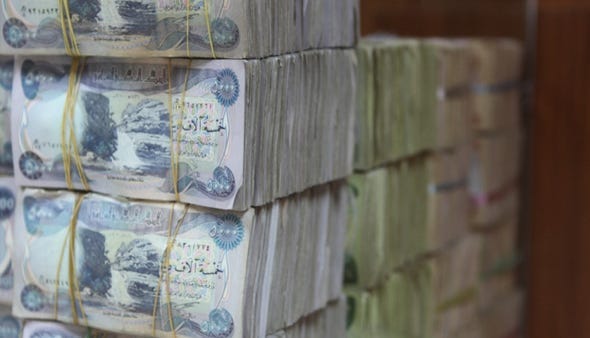
A massive spending hike in the government’s proposed 2023 budget means that the projected deficit will be larger than ever. But should this be a cause for concern?
The government is proposing a 198 trillion IQD budget for the next three years, with projected revenues set at 135 trillion IQD, leaving a budget deficit of 63 trillion IQD.
In reality though, this deficit is unlikely to materialize, a point that Minister of Planning Mohammed Tamim stressed during remarks at the Sulaimani Forum on March 16.
Three factors need to be considered to understand why this is the case. First, successive Iraqi governments have had notoriously low budget execution rates. Poor institutional capacity and excessive red tap mean that Iraq is simply unable to spend inflated budgets, especially funds that are allocated to investment spending.
Second, there is a misconception about how funds are allocated to ministries once the budget is passed. Budgets on paper do not necessarily materialize into actual transfers of cash to the ministries and other administrative units. Operational spending has to be signed off by the Finance Ministry on a monthly basis, whereas the Planning Ministry has to approve capital spending requests. The approval process is easier for some spending items compared to others, such as public sector wages, pensions and social security net transfers.
When it comes to investment funds however, plans need to be submitted before the Planning Ministry can sign off. In most instances, there are convoluted procedures involving a back and forth series of negotiations that often lead to delays in spending approvals, and in other instances, budget requests are denied.
Thirdly, the Finance Ministry is currently holding around 25 trillion IQD in surplus funds that it can use to finance a budget deficit. When oil prices fall below the price set in the budget, the government tends to adopt fiscally conservative measures since Iraq has limited options to finance a deficit. If funds are not available, budgets are inevitably curtailed.
When Iraq last passed a budget in 2021, total spending was set at 130 trillion IQD. Oil prices averaged around $70 per barrel, and yet the government only spent 79% of the budget (103 trillion IQD). Of the 29 trillion IQD allocated for capital spending, only 13.2 trillion IQD was actually spent. Even budgets for wages and social welfare were not fully spent that year.
A similar picture emerges in 2022. Although overall spending rose to 117 trillion IQD, the government generated 161 trillion IQD in total revenues. Furthermore, a significant portion of the 25 trillion IQD supplementary budget that parliament passed last summer has remained unspent. The fact that there was no 2022 budget did limit the government’s ability to spend capital funds, but nevertheless, weak institutional capacity is clear from the figures.
The Sudani government will be keen to capitalize on the windfall from high oil prices, and its ambitious reconstruction agenda is a testament to this, but Iraq’s outdated bureaucratic infrastructure will impede the impulse to rapidly spend funds.