

Divisions have emerged within the Coordination Framework over local government formation in several provinces, leading to the splintering of local alliances.
The parties that make up the Coordination Framework had previously announced the formation of a unified alliance to agree on how to distribute key posts within each provincial government. The Coordination Framework is made up of Nabni (Badr, AAH and Sanad), State of Law, State Forces (Hikma and Nasr), Abshir Ya Iraq (ISCI), and Asas (Mandalawi).
The Coordination Framework had agreed on a formula for power sharing in the 8 provinces where they hold a majority of provincial council seats. As part of that agreement, State of Law and Nabni would be given 3 governorships each, and two would go to Hikma. The Coordination Framework also announced that it was determined to ensure that new governors would be elected in the provinces of Basra, Karbala, and Wasit, where rival parties had secured a majority of provincial council seats.
The formation of local governments over the past few days has shown a breakdown in unity within the Coordination Framework. In the provinces of Basra, Karbala, and Wasit, all three incumbent governors were able to withstand pressures from the Coordination Framework and secure re-election. In Wasit, reports suggest that AAH and Sanad broke away from the Coordination Framework’s position to support the re-election of Governor Mohammed Al-Mayahi. AAH was rewarded with the chair of the provincial council, and Sanad was promised key posts within the local government.
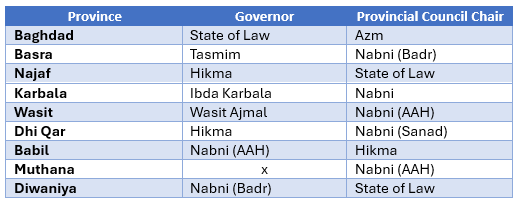
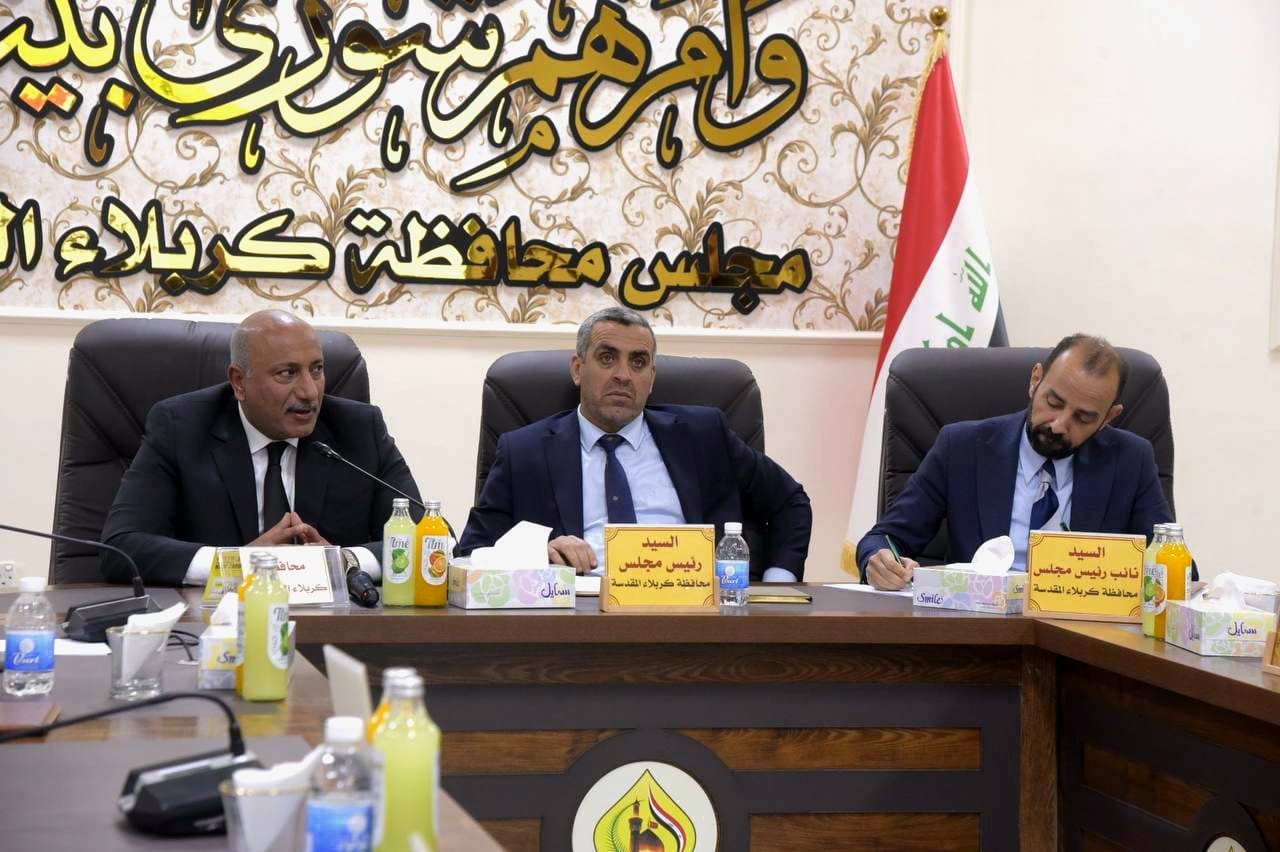
Similarly, in Karbala, which has long-been a State of Law stronghold, the Nabni provincial council member Qasim Al-Yasari allied with the incumbent governor in order to secure the provincial council chair post for himself. Meanwhile, rivalry between AAH and Badr in Diyala has led to delays in the formation of the local government there.
The emergence of local parties that have successfully overturned the dominance of the traditional parties speaks volumes about the fluid nature of Iraq’s political system. Governors that have performed well have been rewarded by the electorate, giving them enough leverage to relinquish their ties to the traditional elite and launch their own political platforms.