

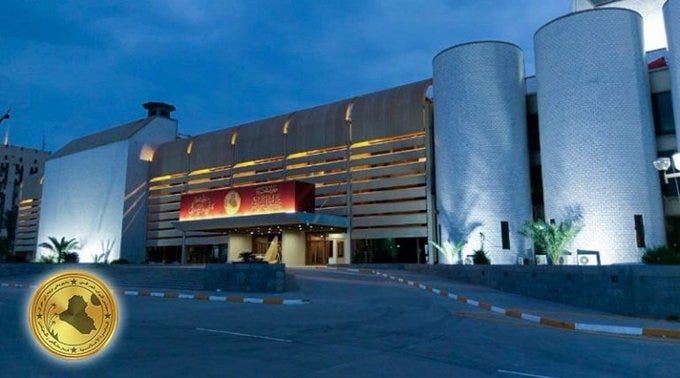
Iraq’s parliament approved the amended elections law in the early hours of March 27 despite attempts by opposition MPs to derail the session. There were multiple efforts to stop the passage of the bill since it was first introduced in mid-February, but the Idarat al-Dawla governing alliance, which vastly outnumbers opposition factions, was eventually able to press ahead without making any major concessions.
Tishreen-aligned groups organized demonstrations outside of the Green Zone over the weekend, but ultimately they failed to mobilize a critical mass of support that could influence proceedings in parliament.
Inside the parliament chamber on Sunday night, some 30 MPs attempted to disrupt the session soon after it began with chants of “No to Sainte-Laguë, no to marginalization”. Emtidad’s Hamid Al-Shiblawi and Alaa Al-Rikabi led the revolt, with Speaker Halbusi repeatedly trying to convince the MPs to stand down, even offering to put alternative amendments up for considerations. Realizing that such an approach would be futile because they lack the numbers to secure a majority vote, the opposition MPs maintained their insistence that the session be adjourned. After a half an hour standoff, Halbusi eventually brought in parliament security to evict the protesting MPs.
The original elections bill that was proposed last month underwent several amendments, mostly related to procedural issues, but fundamentally the approved law retains proportional representation as the system of distributing seats along 18 electoral districts. The law sets December 20 of this year as the deadline to hold provincial council elections.
Opposition to the law centers around the fact that proportional representation disadvantages small parties and candidates running as individuals. But some of the newly emerged parties that performed well in the 2021 elections would likely perform equally well, if not better, under proportional representation. In Dhi Qar province, Emtidad secured just under 150,000 votes, out of a total of 492,000 votes cast. That represents more than 30% of the province’s vote share. Under the previous single non-transferable vote system (SNTV), Emtidad won 5 out of 19 seats in Dhi Qar, or 26% of the province’s seats in parliament. Although it is difficult to calculate exactly how many seats Emtidad would have won under proportional representation, it is possible that they would have won more than 5 seats with the same number of votes.
In justifying their backing of the new elections law, the traditional parties have argued that the existing hyper-fragmentation of factions in parliament undermines the parliamentary process. It currently includes nearly 60 seats that were won by candidates running as individuals, and another 30 seats belong to parties with under four seats each. In an interview on March 23, Ammar Al-Hakim argued that the Sainte-Laguë method would encourage these groups to form electoral coalitions in order to maximize their chances of winning seats.
So-called independent MPs and the newly emerged parties have largely failed to coalesce in parliament despite all claiming to oppose the traditional parties. Last month, 55 MPs signed a motion requesting that a second reading of the elections law be delayed. But competition to secure seats in influential parliamentary committees, as well as personal rivalries, have prevented independents and small parties from uniting under an umbrella coalition, in addition to the fact that an overarching political ideology that could bind these groups together has remained elusive. Even Emtidad, which initially had 16 seats has seen some of its MPs leave the party because of in-fighting.
While it is far too early to predict how competing factions will perform under the new elections law, the return of proportional representation and fewer electoral districts could encourage some of the leading political figureheads to compete on the ballot sheet in the next round of parliamentary elections. That may include the likes of Nouri Al-Maliki and Haider Al-Abadi, both of whom have performed well in previous elections. Whether the newer parties ultimately decide to take part in the provincial elections may depend on their ability to unite under a common platform that can challenge the dominance of the traditional parties.