

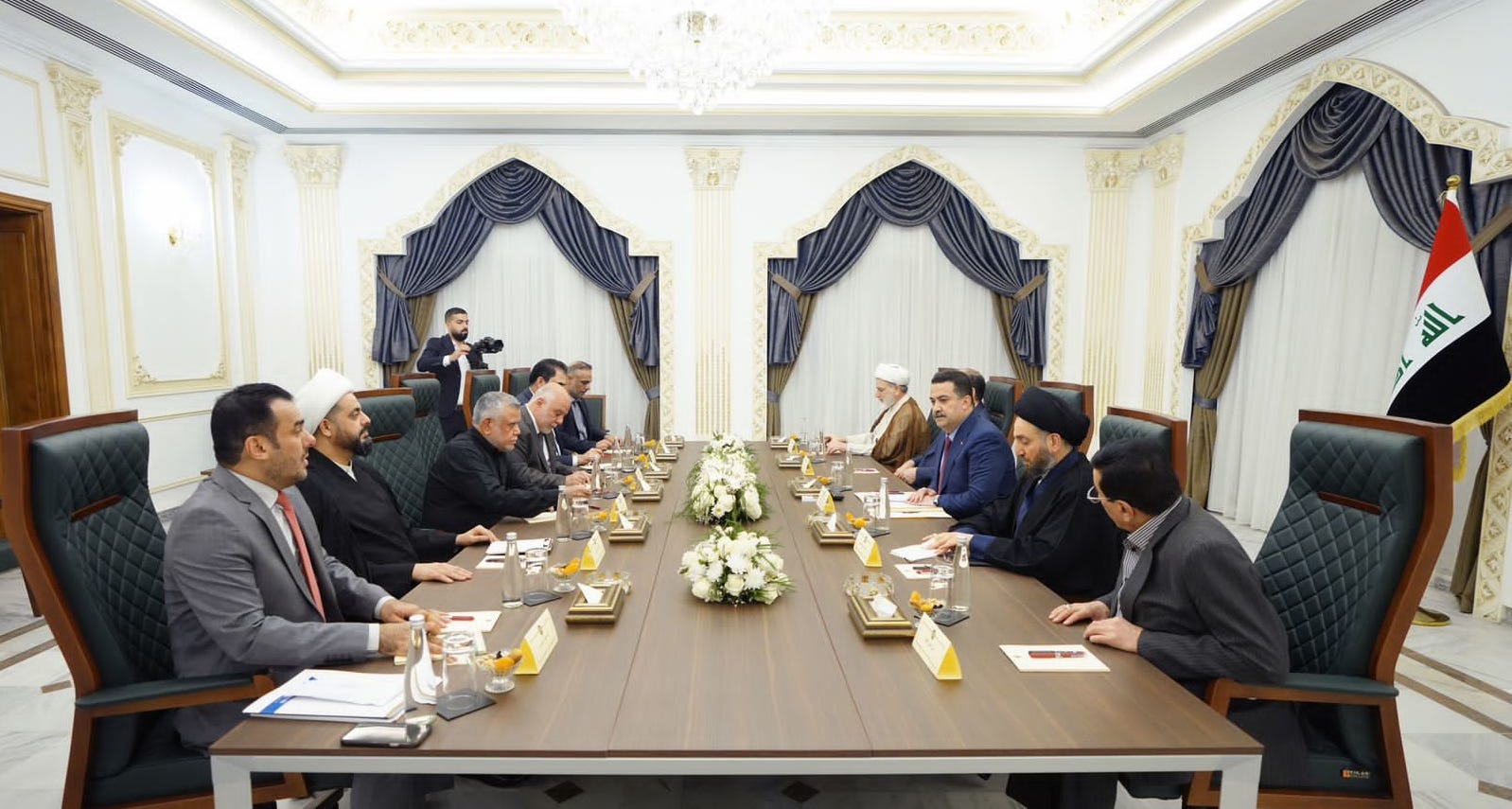
The government formation process has slipped back into deadlock, despite expectations last week that the Coordination Framework would finalize its nominee for prime minister over the weekend. A meeting scheduled for this evening is meant to resolve the issue, but events over the past 48 hours suggest the process has once again stalled at a critical moment.
Just days ago, momentum appeared to be firmly behind Basim Al-Badri as the compromise candidate to replace Nouri Al-Maliki. Signals from Maliki’s State of Law coalition indicated support for Badri, and a formal announcement had been planned for Saturday. That meeting was abruptly postponed at the last minute and pushed to Monday, raising immediate questions about whether the apparent agreement had unraveled.
Following the election of the new president on April 11, the constitutional clock on government formation has resumed. Under Article 76 of the constitution, the largest bloc now has no more than 15 days to nominate a prime minister-designate, who is then tasked by the president with forming the government. With that deadline approaching, the Coordination Framework faces mounting pressure to reach a final decision.
At the center of the dispute are two competing camps: one backing incumbent Prime Minister Sudani for a second term, and the other supporting Badri. Both sides have publicly claimed they command sufficient backing within the Framework. In reality, however, the positions of key figures such as Ammar Al-Hakim and Qais Al-Khazali have remained ambiguous, making it difficult to determine where the balance of power truly lies.
What has been clearer is Maliki’s strong opposition to a second Sudani term, a stance echoed by Humam Hamoudi of ISCI. That opposition has been a major obstacle to consensus, forcing the Framework to consider alternative mechanisms for selecting a nominee.
Last week, attention turned to an internal voting formula among the Framework’s 12 senior figureheads. Under this approach, a candidate would need the support of two-thirds of members, meaning at least eight endorsements. Both the Sudani and Badri camps claimed to have reached that threshold. The decision to convene Saturday’s meeting suggested that Badri, at least temporarily, had the upper hand, but that calculation now appears to have changed.
On Sunday, Maliki’s Dawa Party issued a statement asserting that Maliki himself remains the Framework’s candidate and has not withdrawn from consideration. The statement also emphasized that any replacement must be decided through a majority vote within the Framework. The message was widely interpreted as a reversal or at least a hesitation on Maliki’s part, effectively undermining the push to formalize Badri’s nomination.
Complicating matters further is a growing dispute over the legitimacy of the selection mechanism itself. The Sudani camp has objected to the equal weighting of votes among the 12 figureheads, arguing that it does not reflect political realities in parliament. Sudani’s bloc holds 46 seats, yet under the current formula it carries the same voting weight as factions with only a handful of seats. This has fueled tensions over whether the process is genuinely representative or structurally skewed.
With Badri’s path narrowing, Sudani’s allies have reportedly floated an alternative candidate: his chief of staff, Ihsan Al-Awadi. Such a move could reset the contest and force other factions to reconsider their positions. Maliki, in turn, may respond by advancing a different preferred candidate of his own. Contrary to some reporting, Badri is neither Maliki’s personal choice nor a member of his party, but rather is a candidate backed by Faiq Zaidan, the head of the Supreme Judicial Council.
If both camps continue to block each other, the stalemate could open space for a compromise figure. Names such as the head of the Iraqi National Intelligence Service, Hameed Al-Shatri, could re-emerge, alongside the possibility of a lesser-known candidate as a middle ground acceptable to all sides.
With five days remaining before the constitutional window closes, brinkmanship is likely to intensify as each faction tests the limits of its leverage. Yet the constitution offers no clear penalties for missing the deadline, raising the possibility that Iraq could once again drift into an open-ended political stalemate.
The outcome of this evening’s Coordination Framework meeting will be a key indicator of the direction of the process, whether they can still reach agreement on Badri or if it has unraveled into another round of elite bargaining.