

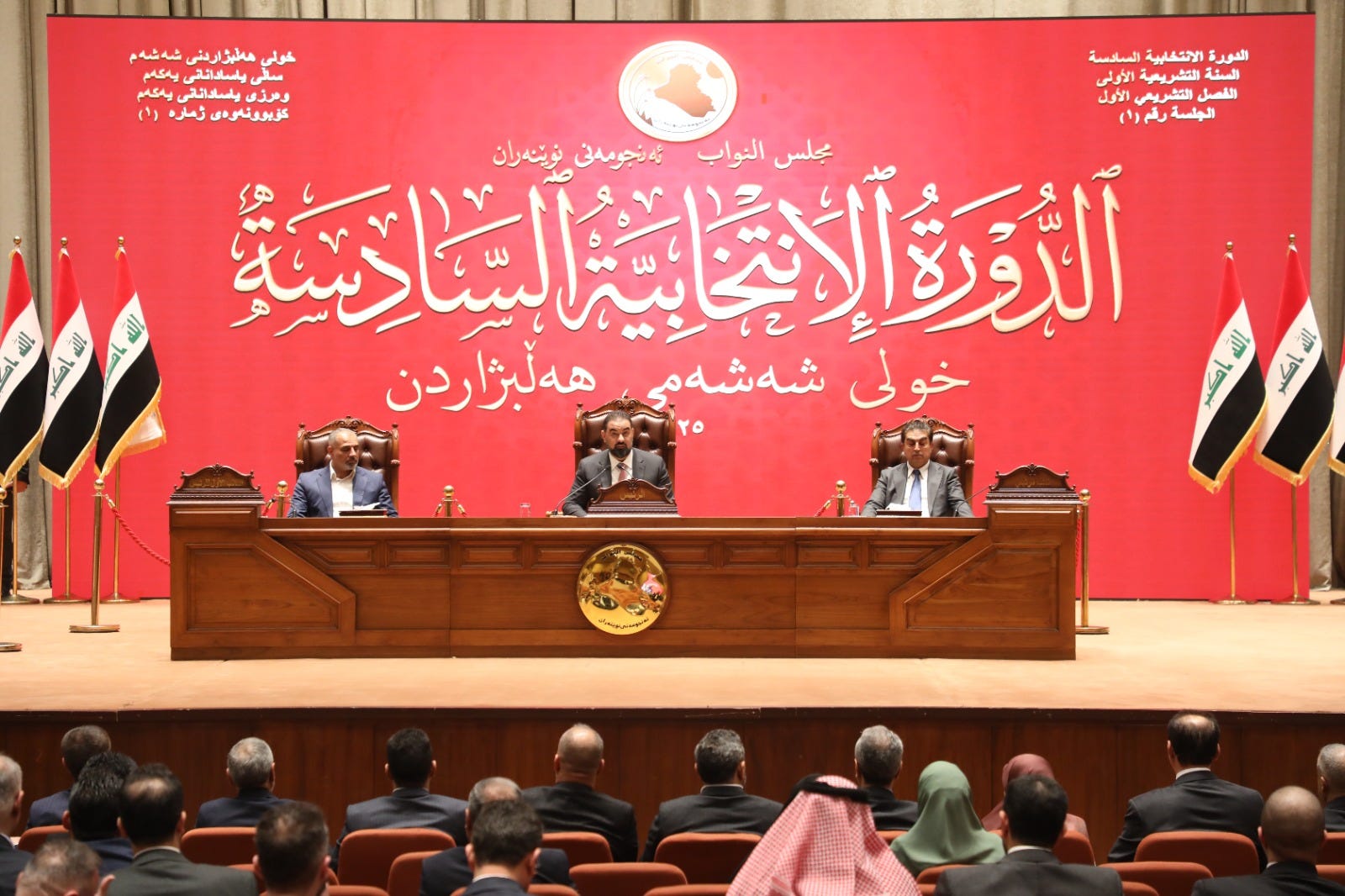
Iraq’s parliament has cleared the first government formation milestone with unprecedented speed, electing a speaker and two deputy speakers in a process that, while at times was politically charged, avoided the prolonged paralysis that has characterized previous electoral cycles. The outcome reflects a convergence of judicial pressure, intra bloc bargaining, and an emerging commitment by the leading Shia forces to uphold an informal power sharing norm that prioritizes the autonomy of Sunni and Kurdish decision-making.
After a week of intensive negotiations, parliament elected Haybat Al-Halbusi as speaker, alongside Adnan Fayhan and Farhad Atrushi as first and second deputy speakers. The speed of the vote marks a clear departure from precedent. Since 2010, parliaments have repeatedly exploited a legal gray area by keeping the first session open for weeks or months to buy time for elite bargaining. That practice was effectively foreclosed this time after the head of the Supreme Judicial Council, Faiq Zaydan, made clear that delaying the election of parliament’s leadership was unconstitutional.
The decisive moment came on Sunday night, when the National Political Council, an umbrella body bringing together the main Sunni parties, announced Haybat Al-Halbusi as its official nominee. The decision was meant to break a long running deadlock between Taqaddum leader Mohammed Al-Halbusi and Azm coalition head Muthana Al-Samarraie, both of whom had insisted on the post. Halbusi’s decision to step aside in favor of his cousin Haybat ultimately secured the support of his counterparts in the council, with the exception of Samarraie, who was absent from the announcement and soon after appeared with Azm MPs to declare that he intended to face off against Haybat in parliament.
The council’s failure to reach consensus on the speaker nomination was a significant blow to the prospect of Sunni collectivism, given that the group’s founding document explicitly committed members to consensus decision making on the speakership. However, when MPs convened the next day in parliament, Samarraie announced that he was withdrawing his candidacy in the name of “the national interest”, saying the decision came at the request of the Coordination Framework. His exit cleared the path for Haybat Al-Halbusi, who went on to secure 208 votes out of 309. Salim Al-Eissawi, who belongs to Khanjar’s Siyada bloc, finished a distant second with 66 votes, while Tishreen aligned MP Amir Abdul Jabbar won only 9 votes.
Although the ballot was secret, the voting patterns were revealing. Eissawi’s tally almost certainly included support from the Kurdistan Democratic Party and possibly Azm MPs. The more important signal, however, was that Coordination Framework factions overwhelmingly backed Halbusi, despite reservations about his experience and profile. The calculation was strategic. Because he was selected by Sunni parties commanding the largest share of Sunni seats, the Framework chose to respect that decision in expectation of reciprocity when it comes to the premiership. This unwritten rule is central to Shia politics. By upholding Sunni autonomy in choosing the speaker, Shia leaders reinforce the principle that the choice of prime minister should be treated as an exclusively Shia prerogative.
Election of first deputy
Like their Sunni counterpart, the Coordination Framework could not agree on a unified candidate for the first deputy speaker post, so two heavyweight figures went head-to-head. The outgoing deputy speaker Muhsin Al-Mandalawi faced Adnan Fayhan of Sadiqun, the Babil governor and a long-standing associate of Qais Al-Khazali. Fayhan prevailed in a single round, winning 177 votes to Mandalawi’s 107. While voting patterns are speculative, it is likely that the KDP and Nouri Al-Maliki’s State of Law backed Mandalawi, while the Patriotic Union of Kurdistan supported Fayhan to secure Sadiqun’s backing in the upcoming presidential contest.
Election of second deputy
The contest for second deputy speaker proved even more destabilizing. What initially looked like a formality, with the re-election of the KDP’s Shakhwan Abdullah, quickly unraveled when Rebwar Kareem of the newly formed Kurdish opposition party Halwest entered the race. Deep seated tensions between the KDP and several major factions, including the PUK, Taqaddum, and Sadiqun, turned the vote into a referendum on KDP dominance. Kareem stunned observers by winning 153 votes to Abdullah’s 117 in the first round, falling just short of the absolute majority threshold. A second round produced a similar result, with Kareem again ahead but unable to cross the required 165 votes. The scale of abstentions and spoiled ballots underscored the resistance to the KDP’s nominee.
At this point, a recess was called to allow bloc leaders to negotiate. By then it was already past midnight, and a decision was taken to adjourn the session and resume voting the following day. When parliament reconvened by early evening on Tuesday, the KDP had agreed to withdraw its original nominee and replace him with another party MP, Farhad Atrushi, the former governor of Duhok. That concession proved sufficient to bring a broader cross-section of Sunni and Shia factions on board, allowing Atrushi to secure 178 votes compared to Kareem’s 104.
The presidency race and the next phase
With the speaker and deputies elected, Haybat Al-Halbusi moved quickly to frame the next stage of government formation. He announced that parliament would accept nominations for the presidency for only three days, with the vote required to take place within 30 days under the constitution. That compressed timeline places Kurdish parties under acute pressure to agree on a candidate, despite their deep internal divisions.
In an effort to prevent Shia and Sunni factions from shaping the outcome, Masoud Barzani released a statement on Monday asserting that the presidential nominee should be selected through one of three mechanisms: by members of the Kurdistan parliament, through agreement among Kurdish MPs in Baghdad, or by consensus among Kurdish factions. He added that the nominee does not have to come from either the KDP or the PUK.
Barzani is well aware that a runoff between at least two candidates is almost inevitable, and his overriding concern is to avoid a scenario in which Sunni and Shia blocs gain influence over the choice, as this would weaken the KDP’s negotiating position in talks over cabinet posts. At the same time, he understands that securing the presidency for a KDP figure would be extremely difficult, given the reluctance of Shia and Sunni actors to break with the established convention of allocating the post to the PUK. Instead, Barzani is likely to push for a compromise candidate who is not closely aligned with Bafel Talabani, potentially by backing a second term for President Latif Rashid.
Before adjourning on Tuesday, Halbusi formally announced that the Coordination Framework was the largest bloc in parliament, clearing the way for it to nominate the next prime minister. Later that night, the new speaker joined a meeting of the Sunni Political Council, including Samarraie, in a sign that despite its rocky start, the Sunni umbrella group intends to remain intact. Its immediate task will be to agree on a common position on the presidency and to negotiate the distribution of the six cabinet portfolios traditionally allocated to Sunni parties.
Taken together, the rapid election of parliament’s leadership reflects not the absence of rivalry, but a recalibration of how Iraq’s elites manage it. Judicial enforcement closed off old delaying tactics, while political actors chose expediency over maximalist demands. Whether that momentum can be sustained through the far more contentious battles over the presidency and the premiership remains the central question of the weeks ahead.