

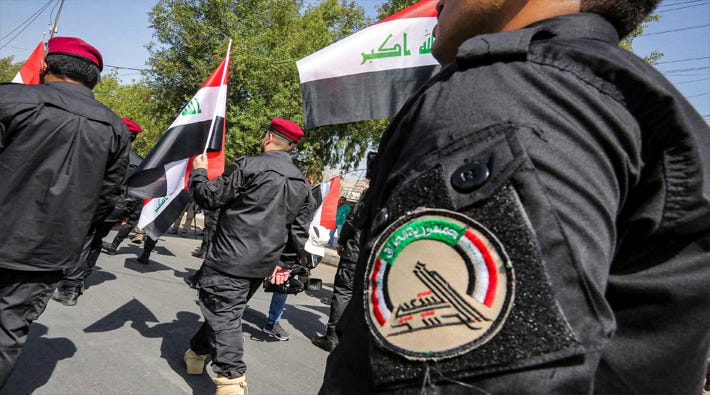
After weeks of political paralysis, parliament held a first reading of a new draft law yesterday concerning the Popular Mobilization Forces (PMF), marking the end of a prolonged legislative stalemate that had gripped the chamber.
The proposed “Service and Retirement Law” for the PMF had become a polarizing issue in recent weeks, prompting sharp divisions and delaying parliamentary sessions. On March 11, the Sudani government formally withdrew the bill. A government memo explained the withdrawal by citing the need to reassess the bill’s financial implications and to align it with ongoing efforts to restructure the PMF.
In its place, the government introduced a new and substantively different draft intended to replace the 2016 legislation that first provided a legal foundation for the PMF during the campaign against Daesh.
The 2016 law consisted of only three articles. While it served as an emergency measure to formalize the PMF during wartime, it left major legal and structural questions unresolved. These ambiguities, particularly regarding command hierarchy, budgetary oversight, and integration into the national security apparatus, have since become a source of tension. The new bill appears to be an effort to fill in these gaps, establishing more precise legal and institutional parameters for the PMF’s role in the Iraqi state.
One of the key goals of the new bill is to articulate the PMF’s purpose in terms consistent with state sovereignty and the constitution. It describes the PMF’s mission as contributing to the protection of Iraq’s constitutional and democratic system, as well as to national defense, territorial integrity, and counterterrorism.
In a particularly notable provision, the bill emphasizes the importance of cooperation between the PMF and other state security institutions including the Ministry of Defence and Ministry of Interior “in a manner that ensures the unity of Iraq, its integrity, independence, and the preservation of its federal democratic system.” These provisions are likely intended as a political message to push back against domestic and international accusations that the PMF serves as a proxy for Iran.
A continuity with the original 2016 law can be seen in the clause that prohibits PMF members from joining political parties or engaging in political activity.
However, the new law leaves unresolved one of the most contentious political questions: the status and retirement of PMF Chairman Falih Al-Fayyadh. The draft bill simply states that the chairman holds the rank of minister and is to be appointed in accordance with the law, but it does not clarify whether retirement age limits apply - an issue that has become a point of contention among factions within the Coordination Framework.
Structurally, the bill introduces new leadership positions, including a Secretary General of the Commission, which mirrors a similar arrangement in the Ministry of Defence. This role is tasked with managing administrative, financial, and legal affairs, including overseeing the preparation of the PMF’s budget. While framed as an organizational reform, the creation of this post appears to serve a dual function: to enhance internal oversight mechanisms and dilute the concentration of power held by both Fayyadh and the Chief of Staff, Abu Fadak Al-Muhammadawi. The law also subjects the PMF’s financial accounts to audit by the Federal Board of Supreme Audit, signaling a broader effort to bring PMF finances under state scrutiny.
Perhaps the most significant structural shift is a provision stating that all deputy positions within the Office of the Chief of Staff are to be appointed by the Commander-in-Chief of the Armed Forces. This clause potentially carries serious political weight. It could theoretically reduce the authority of Abu Fadak and place key personnel decisions in the hands of the prime minister. Given the deep factional divides surrounding Abu Fadak’s role and his ties to Kataib Hezbollah, this may be a calculated move to constrain his influence without directly challenging his position.
While the new bill is far more detailed than its predecessor and appears aimed at asserting stronger state control over the PMF and protecting the organization from being targeted by the United States and its allies, many of its provisions carry implications that remain politically fraught. Whether the law will ultimately gain parliamentary approval and how its implementation will unfold remain open questions. But what is clear is that the law is a vehicle for redefining the relationship between the Iraqi state and one of its most powerful and controversial security institutions.
Below is a full translation of the PMF bill, which will now be debated by the parliamentary security and defense committee:
Law of the Popular Mobilization Commission
Article 1
In accordance with the provisions of this law, an entity shall be established called the Popular Mobilization Commission. It is considered a part of the armed forces, and is subject to the general leadership of the armed forces. It possesses a legal personality represented by the President of the commission or whomever he delegates.
Article 2
This law aims to achieve the following:
Contributing to the protection of the constitutional, and democratic system in Iraq.
Contributing to the defense of Iraq, its unity, territorial integrity, and the fight against terrorism in all its forms.
Contributing to securing and protecting national security.
Building and organizing an integrated military apparatus in terms of armament, preparation, training, and continuous development.
Promoting a culture of defending the homeland and encouraging citizens to volunteer to serve in the Popular Mobilization Commission.
Article 3
The Popular Mobilization Commission shall undertake the following tasks:
Laying out the necessary strategic plans to achieve the goals of this law and the military operations assigned to the Commission by the Commander-in-Chief of the Armed Forces of the Republic of Iraq.
Arming, equipping, preparing, and organizing the mujahideen and formations of the Popular Mobilization and supplying them with advanced technologies.
Providing information and consulting the government on critical issues related to national security and territorial integrity.
Attracting talents, specializations, scientific innovations, and investing them in the Commission's work.
Strengthening cooperation with the Ministry of Defense, the Ministry of Interior, and the rest of the security agencies, in a manner that ensures the unity of Iraq, its integrity, independence, and the preservation of its federal democratic system.
Introducing modern technologies and organizing information systems to develop work methods within the Commission.
Contributing to civil works and public service activities that support public interest.
Caring for the families of martyrs and the wounded, ensuring their rehabilitation, and providing support and assistance.
Article 4
First: The President of the Commission is the supreme head of the Commission and is responsible for implementing its work, setting its policies, and exercising oversight and supervision over its organization, activities, and internal performance. He shall be among those with expertise and specialization, and shall hold at least a bachelor's degree. He issues internal instructions, decisions, and orders in everything related to the duties of the Commission, its formations, and its various technical, financial, and administrative affairs.
Second: The President of the Commission shall hold the rank of Minister and shall be appointed in accordance with the law, and shall be considered a member of the Ministerial Committee for National Security. He may delegate some of his powers to the Chief of Staff of the Commission, its Secretary General, or the Secretary, in accordance with the law, and he shall exercise the powers of the Minister of Defense in applying military laws to the Commission’s fighters from among the military personnel.
Article 5
The President of the Commission shall assume the following tasks:
Outlining the general policy and management of the Commission’s affairs.
Implementing decisions and directives issued by the Council of Ministers and the Commander-in-Chief of the Armed Forces.
Implementing decisions issued by the National Security Council.
Submitting reports to the Commander-in-Chief of the Armed Forces regarding the developments that affect Iraq’s national security and territorial unity.
Issuing rules related to the protection of intelligence and operational information.
Issuing codes of conduct and violations specific to the Commission’s mujahideen.
Article 6
The Commission shall consist of the following structures:
First: Formations directly linked to the President of the Commission:
a. Office of the Chief of Staff
b. General Secretariat
c. General Intelligence Secretariat
d. Directorate of Administrative and Financial Affairs
e. Legal Department
f. Internal Oversight and Audit Department
g. Security and Discipline Directorate
h. Public Information Directorate
i. Directorate of Public Relations and Social Services
j. Directorate of General Planning
k. Fatwa Orientation Directorate
l. Directorate of Communications and IT
m. Muhendis General Company for Construction, Engineering, Mechanics, and Agricultural Works
n. Health Insurance Department of the Commission
o. Fund for Martyrs and Wounded and the Entitlements of PMF Employees and Their Families
p. Popular Mobilization Academy
Second: The Office of the Chief of Staff includes the following sub-formations:
a. Deputy Chief of Staff for Operations, Training, and Combat
b. Deputy Chief of Staff for Intelligence and Information
c. Deputy Chief of Staff for Administrative Affairs
d. Deputy Chief of Staff for Logistics Affairs
e. Deputy Chief of Staff for Medical Affairs
f. General Directorate for Technical Equipment
g. Military Supplies
h. Special Forces Command
i. PMF Provincial Commands
Third: The General Secretariat includes:
a. Legal and Administrative Development Division
b. Institutional Performance Evaluation Division
Fourth: The General Secretariat Office includes:
a. General Directorate for Governorate Affairs
b. Directorate of Educational and Instructional Affairs:
Article 7
First: The person appointed as Chief of Staff of the Commission must be an employee with the rank of deputy minister and possess at least a bachelor’s degree, in addition to a minimum of ten (10) years of service within the Commission or as an officer (First Lieutenant or above), and must meet the required qualifications and experience under the law.
Second: The Chief of Staff of the Commission shall carry out the following duties:
Executing military, intelligence, and security operations and plans.
Supervising the equipping, preparation, and training of the Commission’s mujahideen in all ranks and leadership levels.
Monitoring the enforcement of military discipline within the Commission.
Following up on affairs of the wounded and families of the martyrs and verifying their entitlements.
Supervising military and security procedures in line with the Commission’s goals.
Article 8:
First – The General Secretariat of the Commission is headed by an employee titled “Secretary General of the Commission,” who holds the rank of Deputy Minister, and must hold a university degree (at least a bachelor's) and possess expertise and specialization with no less than 10 years of service in their field. The appointment shall be made by decree based on a proposal from the President of the Commission and in accordance with the law.
Second – The Secretary General undertakes the following tasks:
Managing administrative, financial, and legal affairs.
Submitting proposals for developing the Commission’s work, especially the formations, structure, and administrative bodies.
Supervising training and capacity building for Commission employees in the fields of administration, finance, and law.
Overseeing the preparation of the Commission’s budget.
Following up on human rights issues and cooperating with relevant national and international bodies and organizations in this regard.
Article 9:
First – The Secretariat of the Secretary General is headed by an employee titled “General Secretary,” who must hold at least a bachelor's degree and have no less than 10 years of service in the field, or be a retired officer from the rank of Staff Colonel or higher from various security and military institutions.
Second – The General Secretary carries out the following duties:
Following up and executing directives of the President of the Commission.
Presenting recommendations to the President of the Commission regarding military and intelligence affairs.
Overseeing the management of affiliated formations.
Article 10:
First – The formations referred to in Article (6) of this law shall be managed by an officer whose rank is no less than that of a colonel in the military institutions, or by an employee with the title of General Director in civilian institutions, holding at least a bachelor's degree and with no less than ten (10) years of service within the Commission, with the necessary experience and specialization.
Second – Each deputyship referred to in Paragraphs (A–E) of Item (Second) of Article (6) of this law shall be managed by an officer with the rank of brigade commander, appointed by the Commander-in-Chief of the Armed Forces in accordance with the law.
Third – The names of the formations referred to in Article (6) of this law, and their tasks and duties, shall be determined by a system issued by the President of the Commission.
Fourth – The rank, salaries, and rights of personnel and commanders of the formations referred to in Item (Second), Paragraph (B) of Article (6) shall be determined by internal regulations issued by the President of the Commission.
Fifth – The President of the Commission may establish, merge, or dissolve the formations referred to in Article (6) of this law, based on public interest.
Article 11
First: A legal entity shall be established under this law named the Popular Mobilization Academy, which enjoys legal personality and is administratively and technically affiliated with the President of the Commission.
Second: Graduates of the Academy shall be awarded a certified bachelor’s degree in military sciences.
Third: The Academy shall be administered according to its own internal regulations, including admission standards and the study system.
Article 12
The Commission may appoint no more than three (3) advisors, nominated by the President of the Commission. These advisors shall be experts in the Commission’s affairs, and their selection must be based on competence and experience.
Article 13
It is prohibited for any member of the Commission to belong to a political party or organization, or engage in any partisan or political activity.
Article 14
The Commission’s accounts are subject to oversight and auditing by the Federal Board of Supreme Audit.
Article 15
This law replaces the institutional structure previously regulated under Law No. (40) of 2016, and repeals all other provisions that contradict it. Employees of the Popular Mobilization Commission regulated by Law No. 40 of 2016 shall be transferred to this new structure.
Article 16
The Law of the Popular Mobilization Commission No. (40) of the year 2016 is repealed.
Article 17
The President of the Commission shall issue internal instructions and regulations to facilitate the implementation of the provisions of this law.
Article 18
This law shall enter into force from the date of its publication in the Official Gazette.
Justification Clause
To regulate the functioning of the Popular Mobilization Commission, define its roles, responsibilities, and associated formations, and establish new administrative units to carry out its duties — and due to the necessity of developing and strengthening the military capabilities of the Commission’s formations — and to grant the President of the Commission the necessary authorities to enable him to achieve these goals, this law has been enacted.