

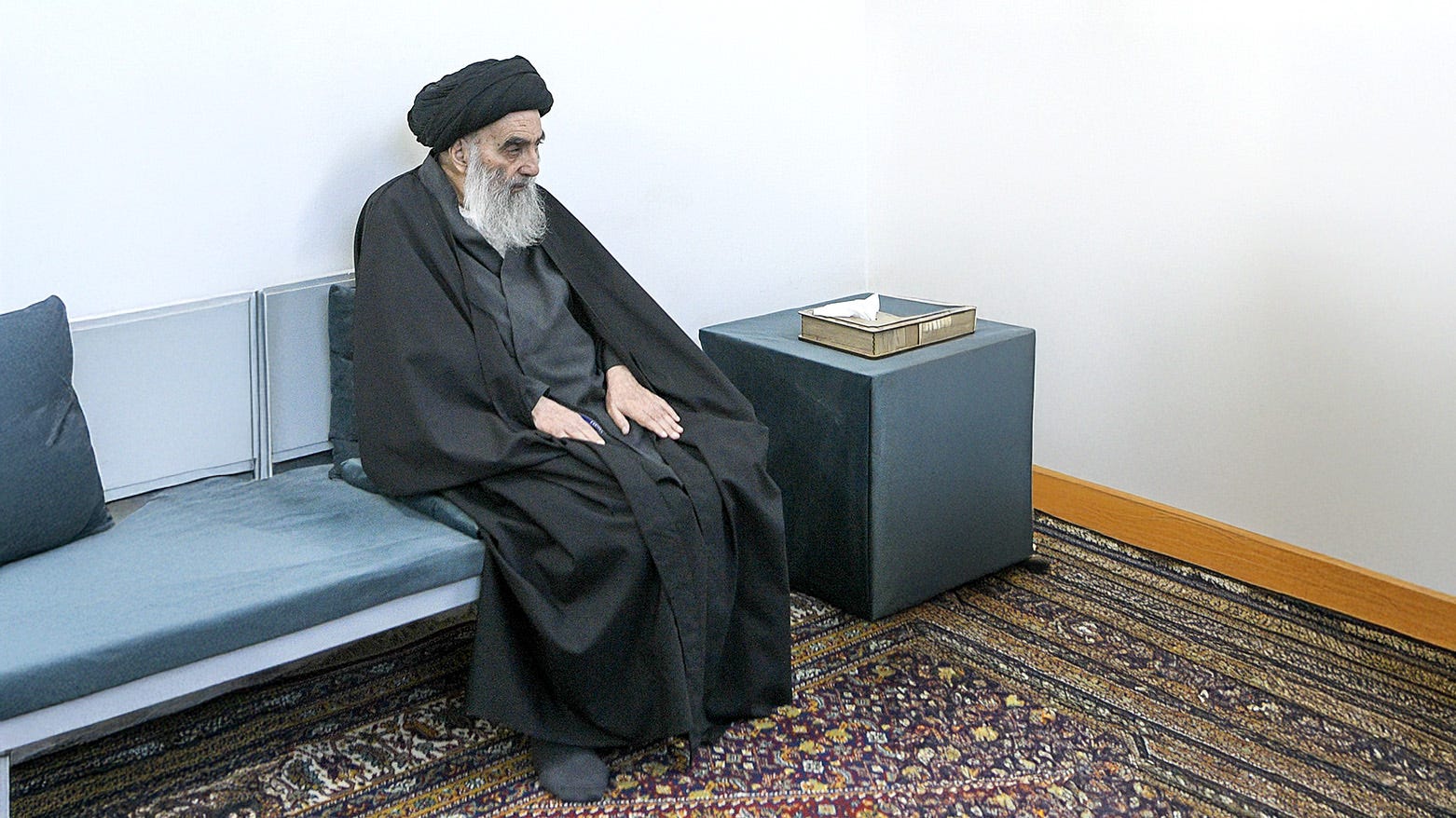
Grand Ayatollah Ali Al-Sistani has issued a public statement in response to the escalating hostilities in the region following the American and Israeli decision to launch a war against Iran. The statement, issued on March 4 by his office in Najaf, reflects the deep concern within the Najaf religious establishment that the conflict could spiral beyond control and destabilize the wider region.
The language and framing of the statement reflect an approach consistent with the Najaf school. It combines strong moral condemnation of the war with an emphasis on adherence to international norms and a clear call for de-escalation rather than armed mobilization.
Below is a translation of the full text of the statement:
“The military aggression against Iranian territory has continued for several days and has so far led to the martyrdom of large numbers of citizens, including many heroes who were defending their country, as well as dozens of children and other innocent civilians. It has also caused significant damage to public and private property. As expected, the scope of the counter-military operations has expanded to include a number of other countries, with many of their areas and facilities suffering harm and damage, in scenes unfamiliar to the region for a very long time.
The decision to unilaterally launch a comprehensive war against another state that is a member of the United Nations, without reference to the UN Security Council, in order to impose certain conditions on it or to overthrow its political system, in addition to violating international charters, constitutes an extremely dangerous precedent. It portends very grave consequences at both the regional and international levels, and is likely to cause widespread chaos and prolonged instability that would bring great suffering to the peoples of the region and harm the interests of others as well.
Accordingly, the Supreme Religious Authority, while condemning this unjust war in the strongest terms and calling on all Muslims and free people of the world to denounce it and stand in solidarity with the oppressed Iranian people, reiterates its appeal to all influential international actors and the countries of the world, particularly Islamic countries, to exert their utmost efforts to stop it immediately and to find a fair and peaceful solution to the Iranian nuclear file in accordance with the rules of international law.”
Several observations can be drawn from the statement.
First, the text establishes a humanitarian framing of the conflict, highlighting the heavy loss of life, including the deaths of innocent civilians and children. At the same time, it acknowledges the role of those “defending their country,” implicitly affirming the right of Iranians to defend themselves against foreign aggression. This formulation allows the Marja’iyya to condemn the war without adopting the ideological rhetoric commonly associated with regional “resistance” narratives. The emphasis on civilian suffering also signals an effort to address a broader international audience rather than only a religious constituency.
Second, the statement places particular emphasis on international law. Opposition to the war is framed as a rejection of unilateral military action undertaken outside the framework of the United Nations Security Council. This reflects a consistent theme in Sistani’s public positions over the past two decades, namely, the insistence that legitimacy in international affairs must derive from recognized legal frameworks rather than unilateral force. By framing the war as a violation of international norms, the statement implicitly appeals to global institutions and stresses the collective international responsibility to pursue de-escalation and an immediate cessation of hostilities.
Third, the Marja’iyya carefully avoids language that could be interpreted as a call for armed mobilization beyond Iran’s borders. Instead, the statement urges Muslims and “free people of the world” to condemn the war and show solidarity with the Iranian people, while calling on governments and international actors to pursue a diplomatic resolution. This restraint is significant given the potential for Shia religious institutions and armed groups to frame the conflict as a broader religious struggle. The Najaf establishment’s message instead reinforces the idea that the crisis should be addressed through diplomacy and legal mechanisms.
Finally, the statement carries important implications for Iraq. By condemning the war while avoiding militant rhetoric, Sistani’s office appears to be reinforcing a broader message that Iraq should not be drawn into the conflict. The emphasis on international law and diplomacy aligns with the position adopted by Iraq’s political leaders who are seeking to prevent the country from becoming another theater of escalation between Iran and its adversaries.
There have already been intermittent strikes on Iraqi territory since the war began, as well as reports of attempts to mobilize Iranian Kurdish opposition groups in northern Iraq. If the current trajectory continues, US and Israeli military actions will likely spill over into Iraq. This prospect is particularly alarming given that Iraq has only recently regained a degree of fragile stability.
Such escalation would come at a sensitive political moment. Iraq’s political elite are still negotiating the formation of a new government, and a widening regional war could easily disrupt that process while weakening state authority. In Baghdad, one of the most pressing concerns is that instability could create opportunities for ISIS to reconstitute itself. This risk is not limited to infiltration from Syria, but it also includes the potential activation of sleeper cells inside Iraq if security forces become overstretched.
Against this backdrop, Sistani’s intervention can be read not only as a moral condemnation of the war but also as a warning about the cascading consequences of regional escalation. The Najaf establishment is signaling that the conflict threatens not only Iran but the entire regional order, including Iraq’s own prospects for longterm stability and prosperity.