

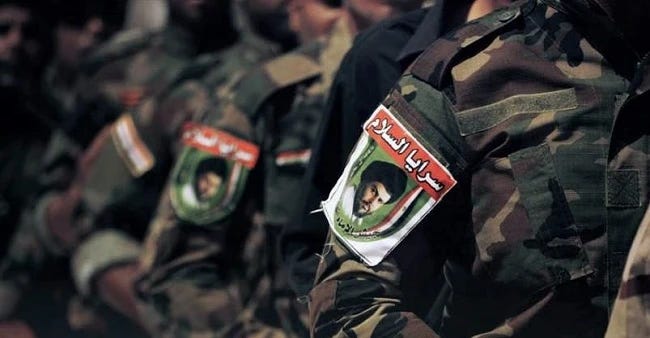
The first significant test of the Zaidi government’s efforts to rein in paramilitary actors is unfolding in Samarra after Saraya al-Salam refused to comply with an order to change the leadership of the city’s operations command.
The dispute began when Hashd Commission chairman Falih Al-Fayyadh issued an order replacing the commander of Samarra Operations Command, Ali Al-Uqayli, with Yousef Mizyan. The move quickly escalated, prompting video statements from Saraya al-Salam members rejecting the decision and insisting that the group would remain in Samarra. Critics of the appointment claim that Mizyan is affiliated with Asaib Ahl al-Haq, a longstanding rival of the Sadrist movement.
In response, members of Saraya al-Salam reportedly deployed across several locations in Samarra and refused to facilitate the handover. The confrontation was particularly sensitive given Samarra’s unique status within the Sadrist movement. Unlike most other parts of Iraq, Saraya al-Salam has maintained a continuous security presence in and around the city since the rise of ISIS and the need to protect the Askari Shrine, one of the holiest sites in Shia Islam. Muqtada Al-Sadr had previously exempted Samarra from earlier freezes imposed on Saraya al-Salam activities, underscoring the city’s special significance in Sadrist security thinking.
Last month, Saraya al-Salam became the first major armed faction to formally begin the process of integration into the Hashd. In practical terms, this involves relinquishing control over its three brigades and adhering to the formal chain of command including the redeployment of its personnel to other parts of Iraq. Following Muqtada Al-Sadr’s announcement separating the group from his Shia National Movement, a government committee headed by Deputy Joint Operations Commander Qais Al-Mohammadawi oversaw the handover of Saraya al-Salam headquarters, weapons, and facilities in Samarra. During a ceremony attended by senior military officials, the group’s flag was lowered and formally transferred to the state, symbolizing the first step in a broader integration process.
The dispute in Samarra therefore exposes underlying disagreements about the extent of that integration and how much control Saraya al-Salam is willing to relinquish over a city it considers strategically and symbolically important. More broadly, it raises questions about the extent to which the group is prepared to submit to the chain of command of the Hashd Commission, particularly if it believes rival factions are influencing key appointments or are themselves reluctant to undergo a similar integration process.
Tensions between Saraya al-Salam and Asaib Ahl al-Haq have deep roots dating back to the split of Qais Al-Khazali from the Sadrist movement and the Mahdi Army. The two groups have repeatedly clashed politically and, at times, militarily, particularly in Basra and Maysan. The perception that the new commander in Samarra is affiliated with Asaib transformed what might otherwise have been a routine personnel change into a symbol of competition over influence in one of Iraq’s most strategically and symbolically important cities.
Contradictory reports continue to emerge regarding the current status of the dispute. On one hand, sources close to Sadr’s inner circle have told reporters that he instructed Saraya al-Salam to comply with Fayyadh’s order and avoid confrontation. On the other hand, reports emerged that Prime Minister Zaidi had intervened to reinstate Uqayli as head of Samarra Operations Command. Adding further complexity, there are also reports that Sadr has dismissed Uqayli from Saraya al-Salam itself, suggesting that elements within the group may have acted counter to Sadr’s instructions.
While the immediate crisis appears to have been contained, the episode carries implications that extend far beyond Samarra. The dispute comes at a time when Zaidi’s government has placed the state’s monopoly on force at the center of its political program. Recent commitments by Saraya al-Salam, Asaib Ahl al-Haq, and Kataib Imam Ali to separate their armed wings from political organizations have been presented as evidence that Iraq may finally be moving towards restricting the possession of weapons to the state.
Yet the events in Samarra demonstrate how difficult this process is likely to be in practice. The challenge is no longer simply whether armed groups are willing to hand over weapons or integrate administratively into state institutions. Rather, it is whether longstanding networks of influence, local security arrangements, and factional rivalries can be subordinated to neutral state structures.
All of this comes ahead of Zaidi’s expected visit to Washington next month. With time running short, he faces pressure to demonstrate tangible progress in bringing armed groups under state control and advancing a credible pathway towards the demobilization and integration of Iraq’s paramilitary factions.