

US Special Envoy travels to Iraq
Foreign Ministry condemns US Ambassador remarks
Muthana elects a new governor
Telecommunication tax comes into effect
Kuwait protest Iraq’s maritime border
Former close confidant of prime minister arrested
This week, Iraq Horizons analyzed the Ministry of Finance’s figures on budget execution for 2025. Further details found here.
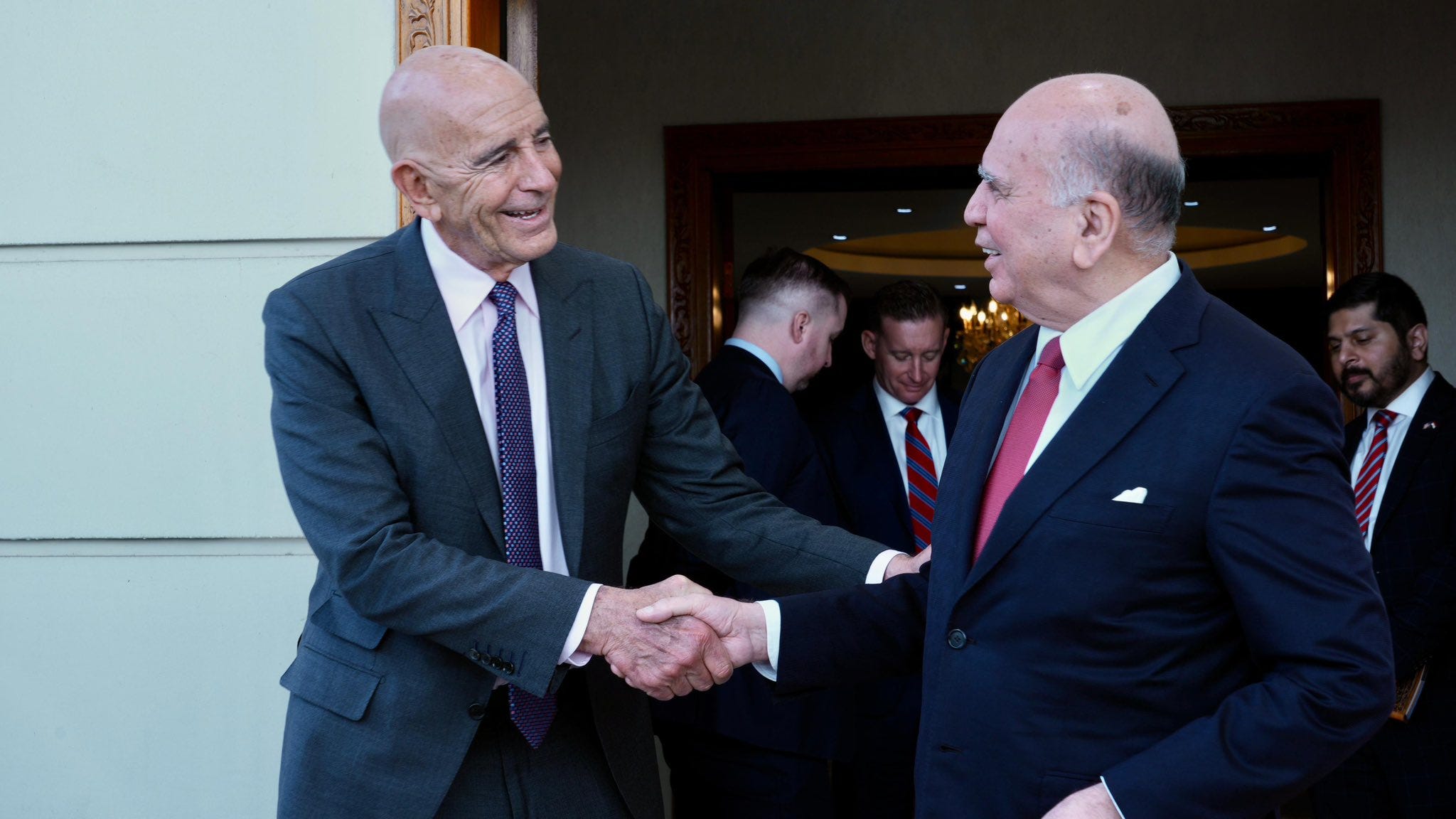
US Ambassador to Turkey and Special Envoy to Syria Tom Barrack traveled to Baghdad on February 22. Over the course of two days, Barrack met with Prime Minister Mohammed Al-Sudani, Foreign Minister Fuad Hussein, head of Judiciary Faeq Zaydan, and head of Taqaddum Party Mohammed Al-Halbusi. Government formation was discussed, as some officials reiterated Iraq’s sovereign right to form a government without foreign intervention. Iraqi officials also warned of the negative repercussions from a war in neighboring Iran. On February 23, Barrack accompanied Prime Minister Sudani to a signing ceremony for two deals involving US owned Chevron. The first deal is with the Basra Oil Company which allows the transfer of management of the West-Qurna 2 oil field from Russian owned company Lukoil to Chevron. The second deal is with Dhi Qar Oil Company and North Oil Company, which will see Chevron develop the Nasiriyah oil field in Dhi Qar and Balad oil field in Salahuddin.
Following the signing ceremony in Baghdad, Barrack traveled to Erbil where he met with the leadership of the KDP Masoud Barzani, Kurdistan Region President Nechirvan Barzani, and KRG Prime Minister Masrour Barzani. On February 24, Barrack concluded his trip to Iraq with a visit to Sulaymaniyah where he met with the head of the PUK Bafel Talabani. Throughout his meetings with Kurdish leaders, Barrack discussed Iraqi government formation, as well as developments in neighboring Syria and its Kurdish community. The presence of Barrack and the absence of Mark Savaya reinforced the belief that the Iraq file has been transferred to Barrack, marking the end of Savaya’s time as Special Envoy to Iraq. Barrack has returned to Baghdad on February 27, on a second trip for further meetings with Iraqi officials.
The Ministry of Foreign Affairs released a statement on February 21 that condemned the remarks that US Ambassador to Israel, Mike Huckabee, made in an interview with Tucker Carlson. When Huckabee was asked about the claims of greater Israel, which would encompass a significant part of Iraq, Huckabee responded that “it would be fine”. The statement from Iraq claims the comments from Huckabee serves as a serious transgression and is inconsistent with the principles of international law and the Charter of the United Nations.
The provincial council of Muthana held a vote on February 24 to elect a new governor after it was announced that Governor Muhanad Al-Atabi had resigned instead of attending a session in which he was meant to be questioned over alleged financial and administrative violations. As a result, the council elected Ahmed Munfi Jawda as a replacement with ten out of 12 votes. However, Atabi released a statement that he has not resigned, and this is “political coup” engineered by provincial council members. Atabi’s removal was led by Ammar Al-Hakim’s Hikma National Movement and Qais Al-Khazali’s Asaib Ahl Al-Haq. Nouri Al-Maliki released a statement following the vote, denouncing the vote and claimed that the governorship of Muthana is part of State of Law’s share within the Coordination Framework and cannot be transferred. Atabi is part of the Al-Nahj Al-Watani Coalition, which is aligned with Maliki’s State of Law. The move will be legally challenged and mirrors the division of the Coordination Framework regarding the nomination of Maliki for prime minister.
The Ministry of Communications released a statement on February 23, announcing it will be implementing the twenty percent tax on calling cards and internet credit. The Sudani government removed the tax in late 2022, weeks into office. However, as part of recent efforts to increase non-oil revenue and cut spending, the Council of Ministers voted to return the tax in the last week of 2025. The ruling has now come into effect, as the government will be collecting the taxes from telecommunication companies on a monthly basis.
The Kuwaiti Foreign Ministry summoned the Iraqi Charge d’affaires on February 21, protesting Iraq’s submission of the coordinates of its maritime borders to the United Nations earlier this month. Kuwait denounced the unilateral move by Iraq and claimed it violated its sovereignty and territorial waters. The following day, various Gulf states released statements of solidarity with Kuwait. Other Arab states did as well, like Jordan, Egypt, and Palestine. Iraq’s Foreign Minister Fuad Hussein responded on February 23, stating that Kuwait had similarly unilaterally submitted its border coordinates in 2014, without consulting Iraq, and that Iraq is doing nothing different. The Council of Ministers also defended its actions during their weekly meeting on February 24.
Yazan Al-Jubouri, formerly a close confidant of Prime Minister Sudani, and the secretary general of Watan Party, was arrested on February 26, after an arrest warrant was issued by a judge at the Karkh Court of Appeal for “engaging in official duties without authorization or legal capacity for the purpose of obtaining financial benefits”. Jubouri allegedly received 42 billion IQD while serving as a middleman between the Prime Minister’s Office and First Iraqi Bank (FIB), a Kurdish-owned private bank. Jubouri was also arrested last year for audio leaks showing similar misconduct, before being released on bail and was later barred from running in the 2025 parliamentary elections.