

Grand Ayatollah Sistani releases statement
Iraq enters three days of mourning
US President calls Kurdish leaders
First Lady of Iraq denounces attempt to involve Kurds in war
Air strikes throughout Iraq
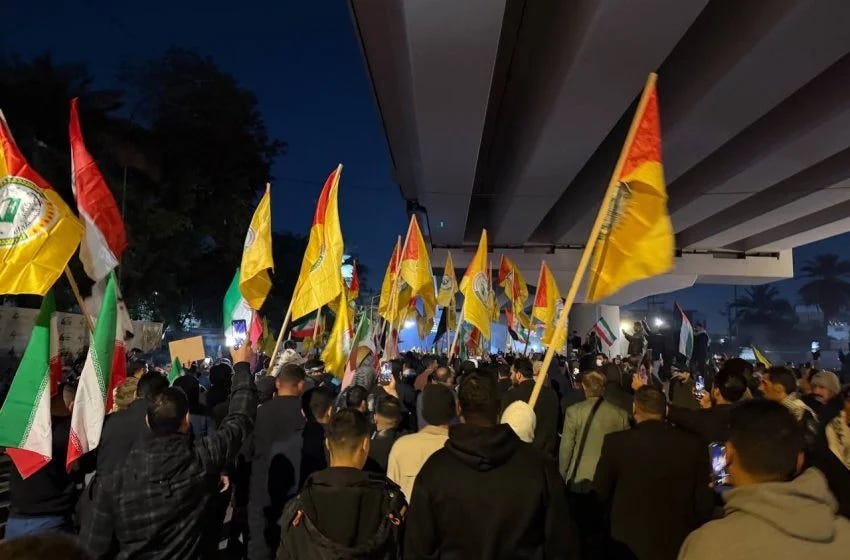
Protests outside the Green Zone
Prime Minister assumes Minister of Defense role
Coordination Framework holds meeting regarding Maliki nomination
Iraqi civil society activist assassinated
The Office of Grand Ayatollah Ali Al-Sistani issued a public statement on March 1, offering condolences to Iranians regarding the assassination of Ayatollah Ali Khamenei. The statement was short and did not mention the United States or Israel. However, three days later, the Office of Grand Ayatollah Sistani released another statement, condemning the war on Iran and calling on adherence to international norms. Further details found here.
The Iraqi government released a statement on March 1, offering condolences to the Iranian people and Muslims around the world regarding the assassination of Ayatollah Ali Khamenei. The statement called for the immediate cessation of violence fueling the conflict and undermining international peace. As a result of this incident, Iraq formally entered a state of mourning for three days. Various other political leaders released statements of condolences, including leader of the Shia National Movement, Muqtada Al-Sadr. Sadr was among the first to release a statement and called on observing three days of mourning before the state formally did. Additionally, Kurdistan Region President Nechirvan Barzani and head of the PUK Bafel Talabani both released short statements of condolences. A KDP delegation led by Masoud Barzani’s brother Sidad and former Deputy Speaker of KRG Parliament Hemin Hawrami visited the Iranian Consulate in Erbil to offer their condolences.
US President Donald Trump had separate phone calls with KDP leader Masoud Barzani and PUK leader Bafel Talabani on March 1. The phone calls were reported by American media and later confirmed by Talabani, who elaborated that President Trump was clarifying the objectives of the war, and dismissed the claims that the US will be using Kurds for a ground offensive launched from the Kurdistan Region. Despite the claims in American media, various Kurdish officials, from Deputy KRG Prime Minister Bafel Talabani to the KRG Spokesperson Peshawa Hawramani, have denied the claims that they will take part in an offensive against Iran or in arming Iranian Kurdish opposition groups.
The First Lady of Iraq Shanaz Ibrahim Ahmed released a strongly worded statement on March 5, that went beyond simply rejecting the rumors of Iraqi Kurdish involvement in arming Iranian opposition. In the statement, titled “Leave the Kurds Alone. We Are Not Guns for Hire”, Ibrahim calls on the international community to leave the Kurds out of the latest conflict in the region. She references the 35th anniversary of the Kurdish uprising against Saddam Hussein in 1991 as an example of when the international community failed to come to the aid of the Kurds. Ibrahim also highlights what only recently happened to Kurds in Syria, emphasizing a history of unfulfilled promises.
Since the first attacks from the United States and Israel towards Iran on February 28, there have been retaliatory attacks from Iran in the Kurdistan Region, primarily targeting Erbil International Airport, where American forces are still based. However, there have been other areas of central and southern Iraq that have been targeted by the United States and Israel. An attack in Anbar on March 1, targeted PMF Brigade 45 and killed at least four people. In the following days, the American presence in the Kurdistan Region was attacked as well as oil fields in Duhok and Sulaymaniyah. Attacks targeting the Kurdistan Region have come not only from Iran directly, but from pro-Iranian armed groups in Iraq, which have claimed responsibility for specific attacks. As a result of the violence in the region, Iraqi airspace has been closed since February 28.
Protests have taken place in Baghdad throughout the week against the assassination of Iranian Supreme Leader Ali Khamenei. Protestors, some of whom are members of armed groups aligned with Iran, took to the streets and marched towards the Green Zone, with the intention to protest outside the American Embassy. Iraqi Security Forces have prevented the protestors from crossing the 14 July (Suspension) Bridge and entering the Green Zone. Clashes between security forces and protestors has led to many injuries. Iraq’s Minister of Interior Abdul-Amir Al-Shimmari visited some of the wounded officers in the hospital.
Minister of Defense Thabit Al-Abbasi has formally taken the oath to become an MP, becoming the eighth minister in Sudani’s cabinet to vacate his or her position. As a result, on March 2, it was announced that Prime Minister Mohammed Al-Sudani will be acting Minister of Defense, based on a decree he issued January 28, 2026, when his other ministers had moved on to become MPs after winning a seat in the November 2025 parliamentary elections.
The Coordination Framework held its weekly meeting on March 5, which had been postponed for over two weeks. Members of the Coordination Framework tried to figure out a resolution to the prime minister nomination, after initial plans to nominate former Prime Minister Nouri Al-Maliki were derailed by US President Donald Trump publicly warning Iraq from going through with the decision. Iraqi media has reported that three quarters of the Coordination Framework have voted to find a new nominee. The decision comes after multiple visits from US Special Envoy Tom Barrack to Baghdad last week, as well as pressure from the head of the Judiciary Faiq Zaydan. Zaydan recently published an article in Saudi outlet, Asharq Al-Awsat, on March 3, reiterating his previously held opinion that the Federal Supreme Court interpreted Article 76 of the constitution, regarding the largest bloc in government formation, incorrectly in 2010 and that this should be corrected with future government formations.
The founder and president of the Organization of Women’s Freedom in Iraq, Yanar Mohammed was assassinated in Baghdad on March 2, outside her home. An Iraqi-Canadian, Mohammed was killed by two gunmen in the Iraqi capital after returning from a trip to Canada. Mohammed is widely known for establishing safe houses for Iraqi women who are victims of sex trafficking. Mohammed was featured in the Aljazeera English documentary on human trafficking from July 2022.