

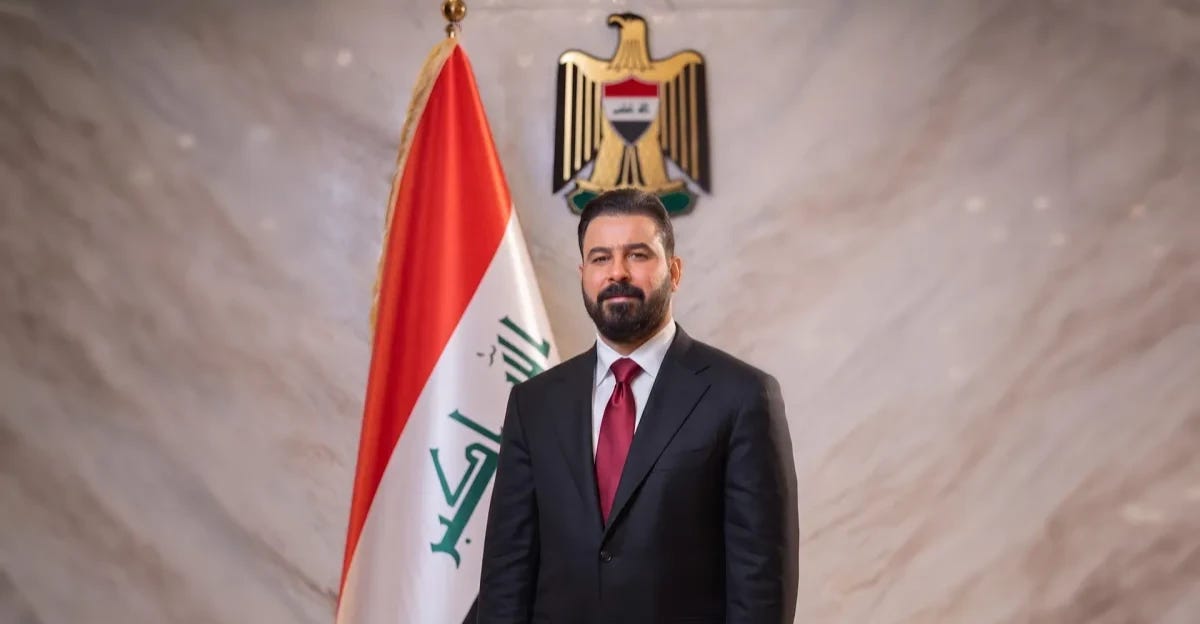
Parliament’s announcement that it will hold a session tomorrow to vote on Ali Al-Zaidi’s proposed government confirms that Iraq’s political blocs have finally reached an agreement on how to distribute cabinet posts after days of uncertainty and delays. Speculation had grown that the parliamentary session would not take place this week due to escalating disputes between the parties over their ministerial shares. The decision to proceed now suggests that at least a temporary political settlement has been reached behind closed doors.
The disagreements revolved around the highly formulaic and transactional process through which parliamentary seats are converted into government positions. In a fragmented political system containing nearly twenty leading parties, most of which seek representation within the executive branch, determining what constitutes an equitable distribution of ministries becomes extraordinarily difficult.
The first and most important layer of disagreement emerged among the Shia parties within the Coordination Framework. Twelve ministries were effectively available for distribution among the five leading factions: Sudani’s RDC with 52 seats, Maliki’s State of Law with 30 seats, Khazali’s Sadiqun with 28 seats, Ameri’s Badr with 19 seats, and Hakim’s Hikma with 18 seats.
Zaidi proposed a formula that would allocate three ministries each to the RDC and State of Law, while Sadiqun, Badr, and Hikma would receive two ministries each. However, this immediately generated objections. The RDC argued that receiving the same number of ministries as State of Law was unfair given its significantly larger parliamentary bloc. Similar frustrations likely emerged from Sadiqun, which holds more seats than its counterparts in Badr and Hikma.
This is where the type of ministry allocated becomes critical because not all ministries carry equal political value. Iraqi political custom recognizes five so-called sovereign ministries as the most prestigious and strategically important portfolios: the ministries of Finance, Oil, Interior, Ministry, and Foreign Affairs Ministry. Under this arrangement, the first three typically fall within the Shia share of government, while the Ministry of Defence is typically allocated to a Sunni party and the Ministry of Foreign Affairs to a Kurdish party.
Negotiations also appeared to have centered heavily on competition between the RDC and State of Law over the Oil and Interior ministries. Hikma also reportedly sought the Oil Ministry, helping explain media reports that Ammar Al-Hakim considered not joining the government.
Some reports have suggested that Hikma could instead receive the Finance Ministry. However, political precedent generally gives the prime minister substantial influence over selecting the finance minister because of the sensitivity and strategic importance of the position. One of the key issues to watch during tomorrow’s session will therefore be whether Taif Sami remains in office or whether Zaidi introduces a replacement.
A second layer of disagreement concerned the smaller Coordination Framework factions that lack sufficient parliamentary weight to independently secure ministries. Because there are simply not enough ministries to satisfy every faction, several parties appear to have been pushed into compromise arrangements.
Reports indicate that ISCI and Tasmim, which together hold ten parliamentary seats, are expected to share control over the Communications Ministry. However, this still leaves other factions dissatisfied, particularly Mandalawi’s Asas party, which holds eight seats and also expects executive representation.
The apparent solution has been to expand the number of deputy prime minister positions without assigning ministerial portfolios. The government could include four deputy prime ministers in total, with two allocated to Shia factions. One of those positions is expected to go to Mandalawi, while another may be assigned to Sadiqun as part of the broader balancing arrangement.
This represents one of the few significant structural differences between Zaidi’s proposed government and the cabinet formed by Sudani. Beyond the addition of deputy prime minister posts, the broader ethnosectarian distribution of ministries appears largely similar to the existing government arrangement. Parliament may also eventually move toward approving two vice presidential posts, something Iraq has not maintained for more than a decade.
The third and most sensitive layer of disagreement concerns US objections to parties with armed factions aligned with Iran participating in government. Washington has repeatedly conveyed this concern to Iraqi leaders, including directly to Zaidi himself. The difficulty, however, is that these factions collectively command at least sixty seats in parliament and expect representation proportional to their political weight.
This creates a major dilemma for the incoming prime minister. Excluding these groups entirely would be politically unworkable domestically, yet openly incorporating them into senior government positions risks punitive actions from Washington. A likely compromise may involve approving only part of the cabinet tomorrow while delaying decisions over more controversial ministries until a broader understanding can be reached with the United States.
Tomorrow’s parliamentary vote will therefore provide the clearest insight yet into the internal balance of power within Iraq’s ruling coalition. Particular attention will focus on the five sovereign ministries, especially who secures the Oil and Interior portfolios from among the Shia factions and whether there will be a shakeup at the Ministry of Finance.
Zaidi will also present his ministerial curriculum, making it important to compare the final document with the draft version leaked last week. Any substantive changes could provide insight into his governing priorities and the extent to which his administration intends to distinguish itself from previous governments.
If parliament ultimately approves the new government, tomorrow will also mark the first time that Zaidi delivers a public address. Given the deep public distrust toward political rhetoric after years of unfulfilled promises and exaggerated reform agendas, attention will not only focus on the composition of the government itself, but also on Zaidi’s delivery style, political discourse, and ability to project authority. His first appearance will shape initial perceptions of his premiership and set the tone for the government that follows.