

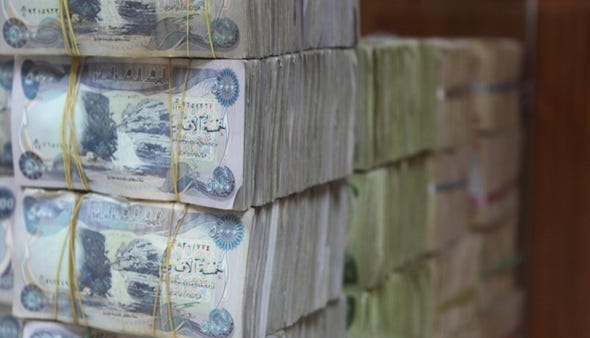
Iraq’s draft 2027 federal budget has been sent to the Council of Ministers for approval after being endorsed by the Ministerial Council for the Economy on September 27, putting the government on course to meet the statutory deadline for submitting the budget to parliament after years of repeated delays.
The Ministry of Finance has yet to publish the draft or disclose its main fiscal assumptions, but preliminary reports suggest total expenditure could reach around 200 trillion IQD, with a sizeable deficit and a significant shift towards program and performance-based budgeting.
The drafting process has been expedited since the Zaidi government came into office in May. The Ministry of Finance completed the draft and referred it to the Ministerial Council for the Economy, the highest government body responsible for setting economic policy. The council approved its referral to cabinet on Sunday, while requesting that comments made by its members be taken into consideration.
The speed of the process marks a significant departure from recent practice. Iraq’s 2019 Financial Management Law requires the government to submit the draft budget to parliament by October 15, providing MPs with two and a half months to review and approve it before the start of the fiscal year on January 1. In practice, successive governments have routinely missed this timetable. The 2021 budget was not approved by parliament until the end of March that year, while delays under the Sudani government meant that the three-year 2023–25 budget was not passed until June 2023.
Both Zaidi and Finance Minister Falih Sari have placed considerable emphasis on submitting the 2027 budget on schedule, reflecting a broader effort by the new government to demonstrate its ability to manage Iraq’s economy during a particularly difficult fiscal period.
One of Zaidi’s first public engagements after taking office was a visit to the Ministry of Finance on May 23. During the visit, Zaidi called for a transformation in the way public finances are managed. He argued that the federal budget should become a “roadmap for the future”, while stressing the need to expand non-oil revenues and reform the traditional approach to government budgeting.
The government has subsequently embarked on a transition away from traditional line item budgeting towards program and performance-based budgeting, one of the defining features of the 2027 budget process.
Sari has also had a strong political incentive to demonstrate a different approach to his predecessor, Taif Sami, who had played a central role in preparing Iraq’s budgets for years. Sari is a senior member of Ammar Al-Hakim’s Hikma Movement, giving both him and his party an interest in demonstrating their ability to manage one of the government’s most important portfolios.
It remains unclear when cabinet will review the draft, although it could be placed on the agenda of its next weekly meeting. Zaidi is likely to push for the budget to be considered by parliament as quickly as possible, but the process could still encounter political delays.
The Coordination Framework may seek to review the draft before it reaches parliament, while negotiations over the outstanding vacant cabinet posts remain unresolved. Parties and coalitions that have yet to secure their expected share of cabinet positions may be reluctant to facilitate passage of the budget before the cabinet negotiations are concluded. There has so far been no indication of a final agreement on the candidates Zaidi will nominate to fill the remaining vacancies.
What do we know about the numbers?
The draft itself has not been published, and the Ministry of Finance has not disclosed its overall expenditure, revenue, deficit or oil price assumptions. However, several figures have emerged through members of parliament and media reporting.
Jamal Kochar, a member of parliament’s finance committee, said on September 25 that Finance Minister Sari had set total planned expenditure at around 200 trillion IQD, putting it on par with the Sudani government’s budget, which was the largest in Iraq’s history. Other reporting suggests a projected deficit of around 65–70 trillion IQD and an oil price assumption of around $55–60 per barrel. If these figures are accurate, they would raise questions about how the Zaidi government intends to finance such a high level of spending, given continued turbulence in global oil markets and constraints on Iraq’s ability to export crude.
According to Kochar, approximately 150 trillion IQD would remain under the traditional line item budgeting system, while 50 trillion IQD would fall under program and performance-based budgeting.
First test for performance-based budgeting
Perhaps the most important structural feature of the 2027 budget is the government’s attempt to begin moving away from Iraq’s longstanding reliance on line item budgeting.
The Ministry of Finance says program and performance-based budgeting will initially be applied to the electricity sector and the governorates of Diwaniya and Salahuddin. Under the approach, allocations are intended to be linked to defined objectives and measurable results, allowing the government to assess the impact of expenditure rather than simply recording how much money has been spent. The model would subsequently be expanded across other state institutions.
Sari has repeatedly stressed this transition during the preparation process. In August and September, he held a series of meetings with budget officials, ministries, governorates and parliamentary representatives focused specifically on preparing the program and performance component.
New public sector commitments
Sari has said that the draft contains provisions to convert eligible contract employees and daily wage workers to permanent salaried positions, although neither the number of personnel covered nor the total cost has yet been disclosed.
The issue is highly contentious because Iraq’s public sector wage bill already represents one of the largest pressures on recurrent expenditure. Any large scale conversion of temporary workers into permanent employees would create obligations extending well beyond the 2027 fiscal year.
This measure sits uneasily alongside the government’s stated objective of strengthening fiscal discipline. The eventual publication of the draft budget will therefore provide an important indication of how the government intends to reconcile demands for new public employment with weaker oil revenues and its commitment to improving the sustainability of public finances.
Beyond the details of the budget, completing the 2027 draft on schedule could help break the cycle of delays that has plagued successive governments. By starting the fiscal year with a budget already in place, the government would be better positioned to begin preparing the 2028 budget on time, rather than carrying delays from one budget cycle into the next. Whether that procedural improvement is matched by substantive reform will depend particularly on the size and financing of the deficit, the treatment of the public sector wage bill, and whether the government’s experiment with performance-based budgeting produces a meaningful change in how Iraq allocates and manages public funds.